Sunday, June 20, 2021

AWAKEN YOUR FAITH AND CHRIST WILL CALM YOUR STORM


     The Sea of Galilee is a freshwater lake, thirteen miles long, eight miles wide and 141 feet deep so there’s plenty of water to drown in. Set among mountains and hills it is also 700 feet below sea level. Being set among hills and so far below sea level means that air currents can cause sudden violent squalls. Boats at that time were little bigger than a large currach. No one wants to face a storm in an open boat on open water. There were no lifejackets back then and water was already filling the bottom of the boat. Imagine then the terror of the disciples. Imagine their panic! It had been our Lord’s idea to cross the Sea and where was He? He was asleep, on a cushion in the stern, in the middle of a storm!

 The Storm on the Sea of Galilee, J.J. Tissot, Brooklyn Jewish Museum.

    There is no experience as striking as one’s own. Our Lord, Who always knew what He was going to do (Jn 6:6), is testing the disciples. He already knew their hearts. Now He was teaching them Who He really is and what He can do. But so terrified are the disciples that they begin to doubt Him. Does He not care? Our Lord certainly wasn’t impressed with their lack of faith. He tersely rebukes the wind and His command to the storm-tossed sea is “Peace! Be still!” Immediately all is dead calm. Notice that our Lord here speaks on his own authority. He does not call on His Father nor on the authority of anyone else. He knew “that by using terms of personal authority … we will be led to recognise His authority as master and creator.”(St Basil On the Holy Spirit 8.21).
    The disciples are stunned. They knew their danger but they also knew that lake. Storms don’t just disappear and dead calm descend. They also knew their Scriptures though. As Job tells us in the first reading God is Lord over the storm and the abysses of the sea. He is in charge even of the chaotic forces of nature. In the Psalms 89 says “You rule the raging of the sea; when its waves rise, you still them” (v.9). We have just read from Ps 107 “He made the storm be still, and the waves of the sea were hushed” (v.29).“The sea is his, for he made it”  says Ps 95:5. There are many, many more references in the Bible to the power of God over His creation. The disciples could not have missed the implications. Yet they also needed to learn the lesson that it was not the Lord but their faith that was asleep and it needed to wake up. Our lives can become so comfortable that our faith can fall asleep.

Image found here.

    We are no strangers to storms up here. Wild weather is part and parcel of the charm and beauty of our country. Likewise there is no life that is free of difficulties and troubles. We can be tossed around from problem to problem, at home, at work, between spouses, between parents and children, between relatives, between neighbours, between friends. We are troubled by sick children or parents, debts, mortgages and bills and the threat of unemployment. We are raised up on the crest of a great holiday or happy event, a birth, a first communion, a wedding and then we crash down into the pain of a death, a bout of illness or some other unforeseen difficulty. Some problems can even threaten to swamp us, sinking a friendship, a marriage, even an entire family.
    The winds of our ever-changing society buffet us too. Our values and beliefs are under constant pressure. All that seemed so certain is now questioned. We are tempted to sin and we fall. It can seem that we will never become genuinely holy. The course that seemed so clear, steady and safe seems now more and more difficult to keep to. No matter how we tack across the prevailing wind we seem to be driven back and make no progress. We seem to be stuck. Worse it can seem that we are to be driven onto the rocks of a lee shore. It is no wonder that at times we can get sick of life, bone weary with effort, and tempted to despair. It can even seem that abandoning the boat and drowning might not be the worst way to go.


    We must remember though that Jesus is “the God-man, who according to his humanity is able to sleep and according to his divinity is able to still the storm”(St. Athanasius). The boat carried our Lord in His humanity but as God He supported and saved the boat. He didn’t need the boat just as He does not need the Church nor creation. He does not need us we need Him (St Ephrem the Syrian) and He is with us.
    We are tried by lockdowns, recessions and so many troubles in our families and communities. It can seem that we are like a sinking boat, about to go down, drowned by waves of problems. Has God abandoned us? No, Christ our Lord will never abandon us unless we abandon Him (2 Tim2:12). Yet just as He tested the faith of His disciples so He tests our faith so that we remember who He is and what He can do. He is always with us but do we live as though that were true? Are we witnesses to Him? Is our faith awake?
    How do we ‘awaken’ our faith in Christ who dwells within us through our Baptism? How do we wake up to the presence of Christ within us, within the Church and within our families, and call upon Him to exercise His power to save us?
    We awaken to Christ by checking our conscience daily and going to confession regularly (I recommend monthly!). We awaken to Christ by prayer, fasting and generosity to the poor. By prayer I do not mean merely rattling off prayers we’ve learnt. By prayer I mean lifting up heart and mind to God. Whatever helps you lift your heart and mind to God is prayer. Call upon him whenever you are brought low, down in the depths of your troubles or when you are thrown high by some some unexpected relief. Tell Him everything, “Load everything on to Him” says St Peter “since He is looking after you”(1 Pt 5:7). It is also true that the family that prays together stays together. Pray together as spouses; pray together as families. Pray especially the rosary. The greatest of all prayers is the Mass. Unite your prayers and sacrifices to Christ in the Mass and you will be heard.
    By fasting I mean going without, especially a ‘going without’ that means another does not have to go without at all. Fast not only from food but above all from doing harm to others. Generosity to the poor needs no explanation but generosity begins at home. Be generous with those in need among your relatives and friends but especially those who cannot pay you back. By prayer, fasting and generosity to the poor we awaken our faith in Christ’s presence and in His mercy. When we open our hearts to His  Presence and His help He will calm all our storms.


Sunday, June 13, 2021

CHRIST THE MUSTARD SEED


     Every life, every era has its own particular trials, tribulations and challenges. The last year has been one for many people. To put it into perspective, though, just study the impact of the Spanish Flu or the far worse Black Death. Just go to genealogy.ie and look up the records of deaths in the Nineteenth and Twentieth centuries. I had to do that while researching the lives of our deceased friars. It shocked me how many people died from TB and how many did not even make it out of childhood. It is easy to forget that our ancestors suffered poverty and oppression that we can only imagine.
    Israel, the Jews, also suffered. They believed God had chosen them. He had made covenants with them. A covenant is a free, sacred agreement established by ritual and oath. God’s covenants with them were the most sacred kind, the kind that established a permanent family bond with them “I will be your God and you shall be my people” He repeatedly told them. He did this with Adam, with Noah, with Abraham, with Moses, and with King David.

Festivities in Honour of King David by J..J. Tissot, (1896-1902), Jewish Museum, Brooklyn.

    God had said to David, "When your days are fulfilled and you lie down with your fathers, I will raise up your seed after you, who shall come forth from your body, and I will establish his kingdom.”(1 Sam 7:12; 1 Chr 17:11) But the Kingdom established by David had split in two after Solomon, Davis’ son, died. Then the people of Northern Israel were taken as prisoners to Syria in 734 BC and again in 722 BC. For a while the southern part, Judah and Jerusalem, remained until 587 BC when Jerusalem and the Temple were destroyed by the Babylonians. Most of the people were deported to what is now Iraq.
    So Ezekiel wrote to console the suffering Jews in Babylon (Iraq) as their world fell apart.  In that quite depressing and traumatic time in the history of God’s people Ezekiel gives a prophesy of hope.  God had not forgotten the word he gave through Isaiah: "There shall come forth a shoot from the stump of Jesse, and a branch shall grow out of his roots.” (Is 11:1) Jesse was David's father and an ancestor of our Lord. God has a plan and his promise, his covenant oath to David, is not forgotten. There be will growth once more.  However no dynasty had ever re-established itself having been brought down.  People found this hard to believe. How could this happen?  Surely Ezekiel was mad?


The Flight of the Prisoners (1896) by J.J. Tissot, Jewish Museum, Brooklyn.


    The “just one” in the psalm is compared to a tree that flourishes, grows, and bears fruit. Behind this is the idea of the Tree of Life and the Tree of the Knowledge of good and evil in Eden, the primordial orchard or garden-temple of God. Adam and Eve didn’t get to taste the fruit of the Tree of Life because they chose to take what had not yet been offered, what did not yet belong to them, the fruit of the Tree of the Knowledge of good and evil. The “just” are those who live their lives according to God’s will and they will become like the Tree of Life. The just will bear the fruit of holiness. 
    The true “just one” is Jesus Christ and He is the only one who is truly “just.” He is the true Tree of Life who bears good fruit in all seasons, eternally. There's an Irish prayer that goes "O King of the Friday, whose arms were stretched on the Cross.  O Lord who did suffer the bruises, the wounds, the loss.  We stretch ourselves beneath the shield of Thy Might.  May some fruit from the Tree of Thy Passion fall on us this night."  It is Christ who has made the Cross and all our personal crosses fruitful.  Baptism makes us part of the Body of Christ and in the Mass He feeds us with His Body and Blood, so we too are called to be the “just one" flourishing in hard times. 


 Crucifixion, apse mural, by Anton and Ekatarina Daineko iconographers, Minsk, Belarus


    The Lord, in the Gospel passage, tells two short parables. In both of them, the “seed” is the Word of God but in two senses. The proclaimed Gospel is the “word of God” and Jesus Himself is the Word of God.  In the first parable Jesus reminds us that a gardener cannot make the seed grow he can only provide the best conditions within his power. Jesus means that the growth of God’s kingdom is a mystery, the work of the Holy Spirit, and no more dependent on human effort than natural growth depends on us. We are responsible for planting the seed of the Kingdom by our words and deeds but the growth belongs to the Lord. We cannot control God's work in our own heart let alone another’s. It is the work of God and we must trust Him.
    In the second parable the Lord also tells us that the kingdom of heaven is like a mustard seed that grows into a great shrub.  The “smallest of seeds” and the humblest is in fact Christ himself, who is both the Word of God, and the “seed of David” whom God promised to King David to “raise up”.  Christ is the “smallest of seeds” because he is poor, humble and lowly, despised by all.  As the prophet Isaiah said: "For he grew up before us like a young plant, and like a root out of dry ground; he had no form or comeliness that we should look at him, and no beauty that we should desire him. He was despised and rejected by men; a man of sorrows, and acquainted with grief; and as one from whom men hide their faces he was despised, and we esteemed him not.”(Is 53:2-3)  Those words were fulfilled on the Cross and from the Cross our Lord says to us "Come to me, all who labour and are heavy laden, and I will give you rest. Take my yoke upon you, and learn from me; for I am gentle and lowly in heart, and you will find rest for your souls.”(Mt 11:28-29)
    Our Lord said the grain of wheat that dies bears much fruit:  "Truly, truly, I say to you, unless a grain of wheat falls into the earth and dies, it remains alone; but if it dies, it bears much fruit.”(Jn 12:23) After His death on the Cross our Lord was planted, that is buried, in the ground. With His resurrection the “mustard seed” of Jesus became the Church, which grew, despite persecution, and grows throughout the world still.
    In Christ, the royal Son of David, Ezekiel’s prophecy did come true but not as expected. Christ turned defeat into victory and the Cross into a throne.  The House of David was reestablished not in Jerusalem but in Heaven.  The new Kingdom of David is the Church that has spread throughout the world. It is an empire of Faith.


    Every life, every era has its own particular trials, tribulations and challenges. Without our Faith in Christ we are no good to anyone. Christ our King offers us the grace to grow spiritually strong and resilient despite life’s troubles, and to bear the fruit of the Spirit and of good works. It is our task to ensure that we are sowers of good seed not of weeds. When we speak well of others, forgive others, do good to others, when we speak the truth in love, and when we oppose evil we are sowing the seed of God’s word. When we do the opposite we are sowing weeds.
    Let us rekindle our faith in Christ and care for it as we would a cherished plant.  Let us have faith in Him and His power to save us. In this dark time when the world is tormented by viruses and lockdowns and their economic and social effects, when the Faith and the Church seem to be failing it’s helpful to remember that times were frequently darker in the past.
    Ezekiel prophesied in exile in Babylon.  Our Lord ministered under Roman occupation. How many centuries were our people oppressed and persecuted here in our native land?  Yet how many saints did our Lord raise up among our people? How many missionaries?
    The Lord prefers to work through the small, the weak and the powerless: mere mustard seeds. He prefers to work in and through ordinary people in ordinary situations.  In unseen ways He makes things grow and change. He cannot be conquered by death, He gives life and He makes things grow; He upholds and overshadows the whole Universe and brings eternal life to those that seek His shade. He is the Tree of Life and if we turn to Him He will feed us with the fruit of His Passion, His very Self, and we will flourish forever.

Monday, June 7, 2021

TASTING HEAVEN, A homily for the Feast of Corpus Christi, Year B

In San Giovanni Rotundo, where St. Pio lived, there was a man, born blind, who met Pio practically every day. After a while it occurred to him that here he was blind yet he got to meet a miracle-working priest every day. Why was he still blind? That thought, wherever it came from, wormed its way into his heart and caused him great distress. Why was he still blind? Why was God ignoring him? 

Then one day St Pio, as he was passing from the church to the friary, stopped and laid his hand on this man’s head. Instantaneously the man was filled with a joy so great he felt he was about to die. He was so afraid he pulled his head away. Pio said to him “That is a little taste of heaven. You can have your sight and risk losing it or you can stay blind and be guaranteed it.” I know this story is true because not only did I get it from a reliable source but it was confirmed for me by an old lady I knew in Dublin. She had been an early devotee of St Pio, went to San Giovanni and met St Pio many times, and even met the man in question. When she met him he was very old and he was still blind.

Last Sunday we celebrated the mystery of the Holy Trinity and the extraordinary privilege we have of not only knowing about the inner life of God but being invited into that Life for all eternity. We have been offered not only the sight of God but a place above the angels on the throne of God. This Sunday we celebrate another aspect of that gift. It is through communion with the Son of the Father, who became man for us, suffered and died for us and rose from the dead for us, that we have eternal Life with the Father. In Baptism we were really and truly united to Christ and all that He has is ours.

God the Son, second Person of the Most Holy Trinity, became truly human for us without ceasing to be divine. His whole life and ministry was one long revelation, a revelation of the Father. On the Cross of Calvary He revealed to us how much He loved the Father and how loveable the Father is. On the Cross He made His eternal worship and love of the Father visible to us and offered that eternal loving worship to the Father on our behalf. This is why the Sacrifice of Christ on Calvary infinitely outweighs our sins. That Sacrifice of Calvary is made present at the Mass. We participate, by the power of the Holy Spirit, not only in Good Friday but in the Eternal Worship of Heaven.


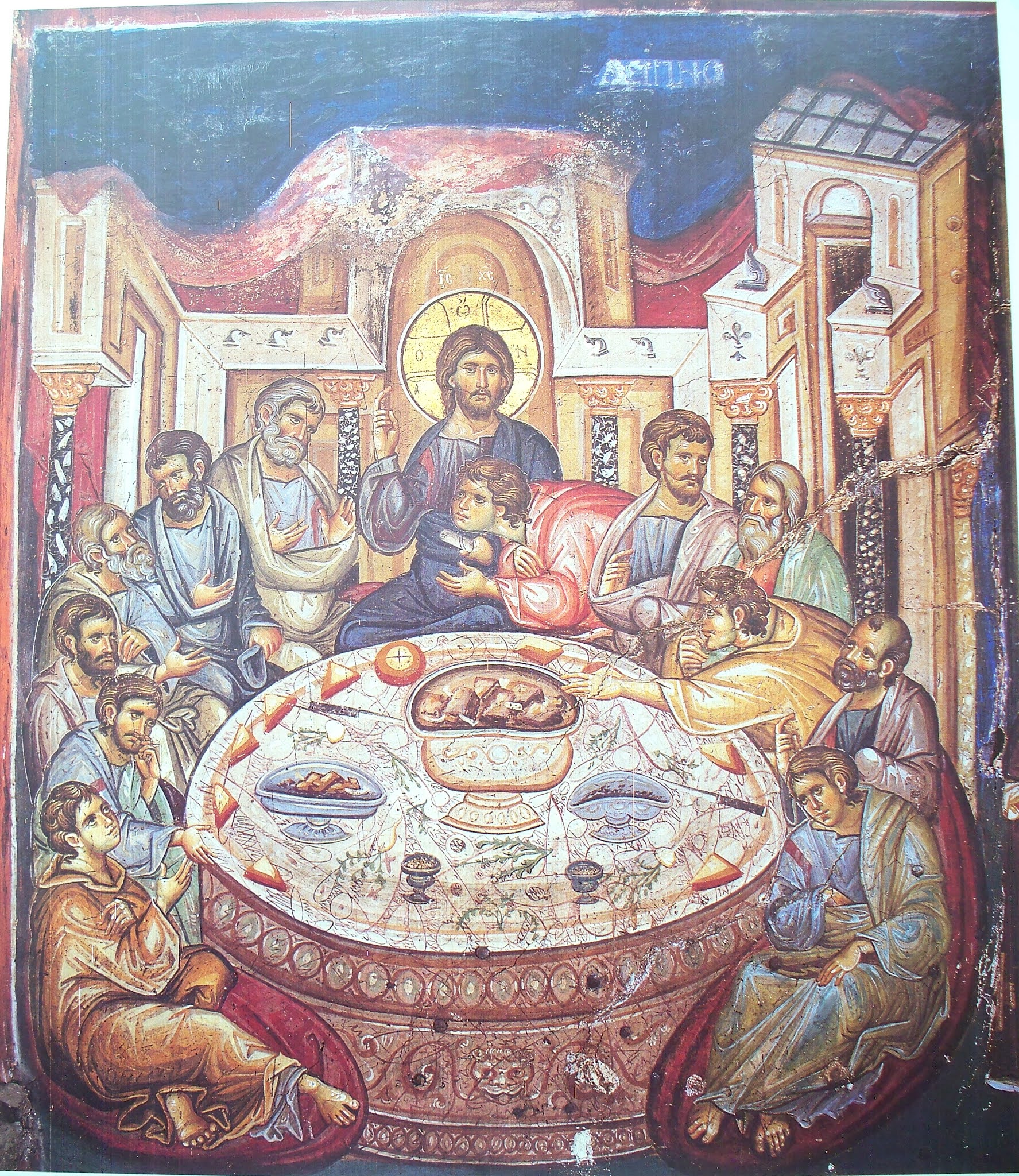
The Holy Synaxis, fresco  by Panselinos (late 13th to early 14th century) in the Protaton church, Karyes, Mount Athos, Greece.


At the Mass the Sacrifice of Calvary, and the Eternal worship of the Father by the Son, is represented in an un-bloody manner. At the Consecration., when the priest says “this is my Body” and “this is my Blood”, the bread and wine, by the power of the Holy Spirit, become really and truly the Body and Blood, Soul and Divinity of Jesus Christ. There is no change that can be detected by our senses, yet He is truly and completely present. Yet this is true of all the Sacraments. There is no visible change in Baptism or Marriage or Ordination. The change is beyond the reach of our senses. Only our faith tells us about the reality that is hidden but the reality does not depend on our faith.

When we receive Him in Holy Communion we receive all of Him not a part of Him. We can receive Him because we have been baptised into Him and so we are already united to Him. We receive Him who offers Himself to the Father on our behalf to bring us to the everlasting peace and joy of Heaven.  Or rather He receives us. He makes us welcome in His Kingdom. We receive, as St Augustine says, “what we will be” but also what we are already by Baptism and Confirmation. 

Many years ago I got to meet a famous Catholic composer and musician. I had bought and listened to his music for years. I queued up and shook his hand, exchanging a few words and then moving on. I told my fellow friars “I’ll never wash this hand again!” Needless to say I did. Yet it was wonderful to meet someone who had inspired me for years.  If the Pope, or the President or your favourite TV personality or pop star were to be here this Sunday how would you have come? Would you not have scrubbed yourself spotless, worn your best clothes and gotten here well ahead of time? Would you not have been excited and attentive to everything they did and said?  How much more then ought we to be attentive when it is not some mere human being who comes to us but God Himself?  But God comes to us not once in a blue moon but every time the Mass is offered.  How ought we to receive Him, to attend to Him, to make Him welcome?

He comes to us not in glory and power but in humility and gentleness under the signs of bread and wine but it is not in any way bread and wine that we receive. We receive the Body and Blood of Christ but not only the Body and Blood of Christ. In receiving the Body and Blood of Christ the Son we receive His Father. In receiving the Father and the Son we receive the Holy Spirit. Holy Communion is communion with the Most Holy Trinity and so we have Heaven within us; our souls are on its threshold. We receive not just a taste of Heaven but Heaven itself. Therefore Holy Communion is more valuable, infinitely more valuable, than the whole Universe.

If Holy Communion is so valuable, so important, so Holy is anyone worthy of it? Remember this if nothing else: No one is worthy of Holy Communion. Not the Pope, nor any of the bishops or priests, nor St. Pio when he was alive, nor St. Anthony, nor St. Leopold nor any of the saints. It is given to us as a free, unmerited gift. We never asked for it, expected it nor could we ever, ever have earned it. The Real Presence of our Lord and the possibility of Holy Communion is His GIFT to us because He loves us and He wants to show us His mercy and unite us with Him for ever in Heaven.

If we receive Him with reverent faith, with repentance for our sins and trust in His Merciful Love; if we receive Him with truly open hearts, our lives will be transformed. By the power of His Presence, hidden in Holy Communion, He empowers us to endure whatever suffering comes our way and to unite it with His suffering. He enables us to love and forgive, to turn the other cheek, to hope for eternal life and to work to grow in holiness. He offers not a little taste of Heaven but the whole reality because He offers us Himself.


Allegory of Holy Communion, second half 16C, 54x45.5cm, Byzantine Museum, Athens.


Saturday, June 8, 2019

ASCENSION SUNDAY

I have for a number of years begun my day with an act of thanksgiving to God for all that He has done for me beginning with creating me and then calling me to be a Catholic Christian, one who has the Faith and is in the Church established by Christ Himself.  He did this by giving me parents who shared that Faith with me.  I am sure you could all say the same.
It is so easy to take things for granted. We don’t really appreciate what our parents did for us until they are gone. I look back and wish I could thank them one more time, or ask their opinion or share some event, some memory, some idea. It is not until they were gone that I really begin to realise their contribution to my life, the sacrifices they made.
           It can be the same with our Faith. It is so easy to take it for granted. It’s contribution to our way of life is easily overlooked, assumed and neglected. It is not until something else has begun to take its place that we may realise what is at stake. In our society the influence of the Faith (and I am not identifying the Catholic Faith with the institution of the Church though there is considerable overlap obviously) the influence of the Faith is waning and being replaced by secularism. Although this is identified as a separation of Church and State (something that had its origins in Christianity by the way) it is something far more than that and far darker. It is a denial even of the Natural Law, the idea that there is an objective standard of right and wrong knowable to every rational person, and therefore a denial of the rational basis of society, of culture and national identity. Of course any intelligent person will quickly realise that such a path leads to subjectivism, indifferentism and anarchy. It is no surprise then that secularism tends towards totalitarianism. After all if there is no objective, rational standard of right and wrong then for the sake of social stability and peace a standard must be imposed, often the standard of the lowest common denominator.
Where did our parents get their Faith?  From their parents and their priests.  They in turn got it from the generations before going right back to Patrick and the first Christians to come to Ireland over fifteen hundred years ago.  They were not Irish.  They were foreigners but they adopted Ireland and gifted us with the Catholic Faith.  Where did they get it?  They got it from the generations before them who got it from Peter and the Apostles who got it from Christ Himself.
           Being Irish is nothing if it is without the supreme blessing of being Catholic.  Better that we cease to be Irish than we cease to be Catholic.  Better that we lose our culture, language, music, art and all that makes us Irish than we lose the Catholic Faith.  Patrick did not come here to tell us how wonderful we were but to enlighten us and save us with the Catholic Faith.  If we lose that Faith then everything we have cannot last.  In losing the Faith we lose everything. By holding onto and handing on the the Catholic Faith we can save all that is precious to us. Our Faith brings us into full communion with the Most Holy Trinity and in that union nothing is lost but it is sanctified and saved. In that communion we become who we were made to be.

It should be no secret why so many are increasingly interested in Eastern religions, paganism and the occult. After all when one lives more and more like a barbarian one is more attracted to barbarism. Consider some of the evidence that has come from the trial of those two boys for the murder of Ana Kriegel. An interest in evil leads to evil. We even have a government minister who has openly praised and even practiced witchcraft.  The bones of the founding leaders of our state must be spinning in their graves! 
Christ is clear: faith in Him and baptism into Him and His Church are necessary for salvation. There is no other way to heaven than through Jesus Christ and membership in His body, the Church.  There is no back door and there are no exceptions. We are commanded to proclaim the Gospel to every creature. To proclaim means more than using the spoken word. It must involve our behaviour. When we do good and oppose evil we proclaim the gospel to others; we make Him visible through the good we do.
Our Lord talks about signs: driving our demons, speaking in tongues, picking up deadly snakes, not being harmed by poison and laying hands on the sick who will recover. You might ask why we don’t see these signs today. 
We see these things in the saints in the miracles God does through them. The Church has always successfully opposed false religions. She has cast out demons. With the rise in interest in the occult there has been a rise in demand for exorcisms. Not only does the gift of tongues appear among her members but even the highest of the spiritual gifts: heroic self-sacrifice. If we do not see signs more widely I would suggest that it is because we do not listen and do not put the Gospel into practice. We do what we want and not what God wants. We listen to men and not to God. The Lord has not recommended that we pick up deadly snakes but that we oppose evil fearlessly. He asks that our Faith not be reduced to something practiced in private, like knitting, but that we openly and actively stand up for Him and for the truth.

We have not been abandoned by our Lord by His ascension. He is closer to us now than He was when He walked the earth. We can receive Him in the Blessed Sacrament and have Him within us.  Through the Sacraments we have one foot in Heaven and can live a double life: we can live in this world while drawing on the power of the next. While we are free from serious sin we have the Holy Spirit with us and therefore the Most Holy Trinity dwells within us. We are each of us walking tabernacles of His Presence, His ambassadors and Apostles sent to share Him with the rest of creation, but above all with those we meet and live with. We are His hands, His feet, His face. If we clearly and courageously proclaim Him nothing will be able to harm us. 

My Vocation Story: a Homily for Good Shepherd Sunday 2019

My parents were practicing Catholics all their lives. We always went to Mass, every Sunday. The Faith was important to them. Somehow in the years prior to leaving school I had lost hold of my faith and I felt lost.  It was through two school retreats with the Marist Fathers that I began to find the light of God returning to my life.  A booklet on Fatima given to me by a priest was the vehicle for God's grace in my life. I began to pray, read the bible, went to confession, (a real confession) and started attending daily Mass.  
Curiosity, the cause of so many of my downfalls and of so much shame, unexpectedly bore the fruit of grace and I went along one night to see a prayer group for myself.  I liked what I saw.  For a few weeks I went to a quiet, reflective, nourishing, a barely ‘charismatic’, little prayer group in my home parish.
In the Charismatic Renewal I found a community, a sense of belonging, filled with joy and freedom, especially in prayer and ministry, and sincere in their search for, and encounter with, the Lord.  The Lord.  Yes, it was the Lord that I found.  Or rather, He found me and He caused me to grow, slowly, gently, at my own pace. From there I joined a local youth prayer group.  
Over the next few years I was a part of bible studies, and various prayer groups.  Then the Lord asked me for something.  Through retreat work, street ministry, working with Camp Jesus, I came to realise that I would have to move on, grow up. One evening a guy had prayed with me and suggested I might have a vocation to the priesthood. Me? A priest? No way!  But the question lingered in my mind and over the next few years I began to enquire whether or not I was ‘called'.   I had an itch I had to scratch!  So I searched. 
I looked at various orders and even went to a vocations weekend with an order and decided not to apply (deep down I KNEW they weren't for me). Then a Capuchin, in confession, asked me "what about us?"  Typical of a Capuchin not to lose an opportunity!  I declined the offer.  At that time I had some contact with the ‘Caps’ and to tell you the truth I thought they were a nice bunch of lads but it just never crossed my mind to think of joining them.  I was walking home one day with a friend and started moaning about the future. He suggested the Caps.  I made lots of excuses until he said that I should stop ‘talking about it and do something.’  The suggestion stuck in my mind.  I had to give it a try and so I went along to two vocations days. These brothers had something of the same spirit I had found in Renewal. The vocation director interviewed me and shrewdly gave me six weeks to apply. I figured I had nothing to lose. I applied and I was accepted. I told my parents a few weeks before I left home.
It was tough leaving home for the first year in Carlow and I shed a few tears that winter when it came to seeing the folks off on the train to Dublin but I got over it. I was one of six guys living with the friars that year in Carlow and we studied theology at the seminary as well as classes in the friary. I got a little anxious during the summer holidays about whether I should apply for novitiate in Kilkenny but I figured that I hadn't seen enough to be sure and re-applied.  They accepted me.  Novitiate was very different.  You wear the habit, work in the friary, and take classes in prayer, Franciscan History and Spirituality among other things. One year later, on the 9th of September 1990, I vowed to live for three years in obedience, without property, and in chastity according to the Gospel of Jesus Christ and the Rule of St Francis. Here in the Capuchins, in the spirit of St Francis of Assisi, I had found the Spirit of our Lord Jesus Christ.
I then moved to Dublin. My first year was a ‘Franciscan year’ just living our life in community, praying and working. There followed three years of philosophy, and then a year on a ‘pastoral leadership’ course preparing for final vows. I made my final vows in 1995 and then spent a further three years studying theology.  I was ordained a deacon in 1998. I spent my diaconate year in a parish in Cork before being ordained a priest on September 11th, 1999.  After ordination I spent two years in a parish in Dublin before being transferred to work in a Secondary School where I spent twelve quite happy years. I came away with a great respect for teachers. Like the nurses they do not get the credit they deserve.
After that I was moved to Cork to work as a chaplain to the University. That was a mixed experience. I really enjoyed working with young Catholics who wanted to know and live their Faith but let’s just say I did not take to University life. I only spent a year and a half there before a bad car accident changed all my plans. There was a silver lining in that I got time to do a Masters in Scripture. 
The priesthood, especially within religious life, is varied.  A priest should have a prayer life but he does not spend his whole day in prayer even among monks.  He is there to a spiritual father to others, to lead, guide, teach and defend the people of God. He is supposed to be there in good times and bad, especially when he’s needed.  Most of a priest’s work is unseen.  He is not a social worker.  He is not a counsellor.  He is an ambassador for Christ.

No vocation is easy. There are ups and downs for everyone. The reason there is a shortage of vocations is not that the Spirit stopped calling. It’s because people stopped listening. Not just those called to the priesthood or religious life but all the people of God. Here and across the civilised world people have decided to have fewer children with huge consequences for the world but also for the Church. The answer to the vocations crisis lies with young Catholics, not just those called to priesthood or religious life, but even more so with those called to marriage.  We need large and committed Catholic families. We need committed Catholics who know and believe the Faith and put it into practice.

Friday, April 19, 2019

LET US GO TO THE TREE OF LIFE a brief homily for Good Friday


Christ is upon the Cross or as even scripture calls it the ‘tree’.  This ‘tree’ symbolises both the Trees of Paradise and the Oak of Mamre.  Under the Oak God sat down to eat with Abraham and Sarah and promised them descendants, as many as the stars of Heaven, royal and holy.  The Trees of Paradise bear fruit that heal the nations.  Under this Tree we are offered healing, we are offered life or death.  His crown of thorns echoes His Eternal Crown as Lord and King of all that exists.  His arms are outstretched for they embrace all space and time, the past and the future.  Everything is in the shadow of the Cross for by the blood of Christ all things in heaven and earth, whether visible or invisible, are subject to Him and reconciled to God.  The cross is the epicentre of history.  Like a tree it is rooted in the earth but it reaches Heaven for Heaven has reached down and sanctified the Earth in His Incarnation.


What does He do that cross? What can the death of one man achieve? But He is no mere mortal.  He is both God and Man. On the Tree of the Cross Christ offers the Father a perfect act of worship. His whole life has been one long revelation of the Father for that is not only His mission but His very nature as Son. It is as if His whole life were one symphony that now reaches its extraordinary crescendo. It is on the Cross that the Son shows us how loveable, how worthy of obedience, how truly good the Father is by suffering and dying.  On the cross He reveals to us the Son’s love for the Father and offers that perfect love to the Father on our behalf. He offers the Father His loving humility and obedience and empties Himself even to embracing death for us.  The Cross is the heart of the Most Holy Trinity laid bare. Offering His Sacrifice through His human nature, His human body and soul, He makes of Himself and His Cross our means of salvation. He makes of the Cross a Throne of mercy, the Throne of Heaven and a Gateway to that Heaven. 
Come forward then and kiss the wood of the Cross and with your lips and your heart knock upon the Gate of Heaven and ask entry.  His arms hold the Gates  open for you.

Come kiss the tree of life and ask Christ to plant the root of His Cross in your heart.  Ask him to break the rock of sin and the hardness of all our hearts so that the Living Spring of the Spirit can well up to Eternal Life within us; so we can bear fruit in union with Him, fruit for the healing of the world.

Sunday, April 7, 2019

CHRIST THE BRIDEGROOM EXTENDS HIS MERCY TO US: a homily for the Fifth Sundayof Lent, year C (Jon 8:1-11)

This is one of the more famous stories about our Lord, made famous in modern times by films like Jesus of Nazareth and the Passion of the Christ.  It is poignant too.  The sinner, a woman, dragged out into public and exposed, faced with judgment and the risk of a horrible death. Now I am sure we all know, even among our relatives, married people who are in second ‘relationships.’  I have relatives, close relatives, in that situation.  Loving others does not mean approving everything they do but neither does it mean we can be judge and jury.  We are to be the mercy of God that helps others live according to God’s plan.
Our Lord is in the Temple, the centre of Jewish religion and here at the centre of Jewish religion our Lord is confronted by his enemies while He is teaching.  The Pharisees and scribes (lawyers) set up a trap for our Lord, that is, trying to set up a conflict between him and the people. They drag in a woman caught in adultery.  Could you imagine that happening to someone in your family?


Adultery had a double infamy among the Jews of that time because in the Old Testament it is often used as a metaphor for idolatry: of infidelity to the true God and the worship of false ones in His place.  If He allowed the stoning they could accuse Him of inconsistency since He taught about the mercy of God.  If He rejected the stoning they could accuse Him of rejecting the Law and their religion and by extension of approving of sin and even idolatry.  Note that His opponents misrepresent the Old Testament.  Yes it punished adultery with death by stoning. It did so teach the Jews the seriousness of sin. The Law commanded the death of both parties to the adultery and since it takes two to tango: where is the man?  Where, indeed, are the Old Testament injunctions to seek the conversion of those who do wrong?
Our Lord bends down and writes on the ground, in the dust of the temple floor, but John does not tell us what our Lord wrote! It could be a reference to an event in the book of Daniel where a hand appears and writes on the wall warning the pagan King Belshazzar that he and his cronies have been measured, weighed, found wanting and their kingdom would be given to another nation, the Persians.  Jeremiah says that “Those who depart from you shall be written in the earth” which means that  they will lose everything and no one will remember them. Perhaps He is pointing to Exodus where God wrote the Ten Commandments, the heart of the Law, on stone tablets. If so then our Lord is reminding them that He is the author of the Law and knows its true intent.  This would fit with the most common suggestion that He was writing down their sins.  Perhaps all of the above are alluded to.  


Then He famously tells them His judgment “Let him who is without sin cast the first stone.”  Remember that our Lord elsewhere said “For with the judgment you pronounce you will be judged, and the measure you give will be the measure you get.”  In other words if they want to stone the woman for her sins they ought to expect the same punishment!   Again He bends down and writes.  By bending down He shows both that He is not intimidated by them and He gives them the psychological space to reconsider.
The accusers leave starting with the eldest. At least they know their sins. As it says in the Psalms: “They have all turned aside, all alike have become unprofitable; there is not one who does good, no not even one.” But our Lord is the source of the Law and Justice itself so how can he let the woman go?  
Perhaps here we have another allusion to Genesis.  In Genesis 18 God and Abraham haggle over how many just men it would take to save Sodom - a city so evil it gave its name to a sin.  At least haggling is how it is usually understood.  If one reads the story carefully it emerges that God chooses to consult Abraham as the one would consult a  trusted advisor.  God destroys Sodom not because there are no just men in it but because Abraham does not believe in God’s compassionate mercy enough to ask for its salvation.  These people do not believe in God’s compassionate mercy enough to ask for the woman’s salvation but Jesus shows it anyway.  
In response to his question “Has no one condemned you?” she says “No one, Lord.”  ‘No one’ He takes to be a confession of her guilt.  “Lord’ He takes as a confession of faith.  He who writes His Law on our hearts by the power of the finger of God, that is, by the Holy Spirit shows mercy to whomever believes in Him and asks.  Note that Jesus does not say to the woman “It’s ok, I understand.  Take your time to think about changing your life.”  Nor does He say “Don’t worry I am full of mercy.  Keep on with your way of life and all will be OK.  I will look after you and you’ll get to Heaven.”  He says none of these things.  Instead he is direct: “Go and do not sin again.”  Our Lord revealed His justice and His mercy.  He neither denies the Law nor approves its enactment.  He is the one without sin and He chooses not to stone the woman. Yet He does not let her sinful accusers stone her either.  That they turn away shows that they had no real concern for the Law anyway nor did they care for the woman’s soul.
All sin is a form of idolatry: putting something other than God at the centre of our lives, usually our own will. Earlier in John’s Gospel, at the wedding at Cana and again at the well in Samaria, our Lord revealed that He is the true Bridegroom of Israel.  It is against Him that all sin is ultimately done.  He is the true and faithful spouse who has been betrayed by the idolatry of mankind; our idolatry.  He is the victim of our adultery. Therefore we are that woman dragged before the world and condemned by the evil spirits.  Christ the true bridegroom extends to us His mercy and the commands that we ‘do not sin again.’
The Lord has shown us how we are to deal with our own sins and the sins of others.  As sinners we should acknowledge our wrongdoing and throw ourselves at His feet trusting His mercy.  When it comes to the sins of others we should bend down in prayer and reflection, read the Law of God written in our hearts, that is, our informed conscience, and remembering our own faults and failings, extend to others the mercy God has extended to us. Let us drop from our hands the stones of judgment and condemnation so that we are free to receive God’s mercy and to be of service to others.  

However let us not call evil ‘good.’  Let us not pretend that adultery or any other sin is OK with God or with us.  Let us remind each other not to do evil but to do good instead.  Christ has extended HIs loving mercy to us and driven back the forces of evil that would condemn us.  He has restored us to life and made us holy by His grace.  It is up to us to share that mercy with others but in the truth and in love.  

Sunday, March 24, 2019

YOU KNOW NEITHER THE DAY NOR THE HOUR: REPENT AND BE CONVERTED. A homily for the Third Sunday of Lent Year C.

The one fact of life is that we will all die. With death will come judgment.  The Church teaches that not only will there be a general judgment on the last day when all mankind shall face God together but that each of us will face a particular judgement at the time of our death.  Those who die in the state of grace (that is without un-repented mortal sin on their souls) and are worthy go straight to Heaven.  Those who die in a state of grace but not yet made amends for their sins or though they have unconfessed mortal sins on their conscience die in sincere repentance go to purgatory.  Those who die unrepentant of their mortal sins go to Hell not because God wants or sends them there but because they have freely chosen to go there. Both Heaven and Hell are eternal and we must choose one or the other.  Purgatory, though the souls there suffer terribly, is only for a time until those souls have made amends and learnt to love as ought to have here on Earth.  We do not know how long we have left so sort things out while you have the chance.  In confession we are like a rotting corpse that by the power of God is raised to life and the fullness of health.  When we confess a sin God chooses to erase it.  It is gone forever.  We still have to try to undo that harm we have done but to God we are innocent.


So while you are here in this life check your conscience daily and go to confession regularly. There may be sins that you’re forgetting or not taking seriously enough. Never intentionally keep back a sin when confessing.  Besides receiving Holy Communion in a state of grace confession is the most effective way to grow in holiness.   Remember that mortal sins must be confessed, what the sin was and how often you did it.  Jesus wants to touch each of our wounds and heal them one by one.  Before confessing something, try to be resolved never to do it again.  A thief who confesses and then goes out planning his next crime has not actually repented.  Though absolved he cannot benefit from the grace of the Sacrament.  Start afresh and look for things that you can change to help you in your resolution!
One reason that people lack a firm purpose of amendment is that they don’t believe they can actually stop a certain sin. They forget that the real battle is between our ears.  If we persist in turning our thoughts away from evil and toward good we will, by the grace of God, eventually be free of even the most addictive sins. Prayer and reading the Bible and the writings of the Saints helps immensely. The sacrament of confession is far more powerful than our human efforts could ever be. 
How many of us give the Lord the respect and honour He deserves? Try to speak of your God, your creator and Saviour with attention and reverence.  Speak about your God as you would about someone you truly love and honour. It should cause us pain when we hear someone take the Holy Name in vain.  You wouldn’t let someone disrespect a family member like that so why let them do it to Jesus who saved you? Remember that in Church you are in God’s house. Here we talk to God and no one else.


Confession is an act of humility and humility is so important that sins against it must also be confessed.  We need to confess and repent of our pride: like taking credit for something without reference to God and desiring that others give you that credit.  Giving credit externally to God for something while actually believing that you earned it and hoping that others will believe that you earned it, too. Desiring to be esteemed above what you really are. Desiring to be better than others. These are sins of pride.
There are many ‘little’ ways in which we are “unjust and unreasonable” to our neighbour.  We may condemn every little thing in our neighbour and excusing ourselves of important things.  We may selling very dearly and buy at bargain prices.  We like to have things we say taken in the best sense but we are tender and touchy about what others say to us.  Preferring one person over another because of their class, wealth or contacts or because they make us appear socially superior is also an injustice. In short, we often don’t treat our neighbour as we would like to be treated ourselves.
We ought not to judge anyone unless required by our position or office. When we are required to judge, then we must strive to pass along God’s judgment without distorting it with our own ideas and passions.  Gossip can lead to slander, that is, falsely imputing sin to another. This sin is doubly bad because it is an offence against truth and it robs another of their good name. “Beware of falsely imputing crimes and sins to another, revealing his secret sins, exaggerating those that are manifest, putting an evil interpretation on his good works, denying the good that you know belongs to someone, maliciously concealing it or lessening it by words.” (St Francis de Sales)
There’s a multitude of chances to serve Jesus by doing good in each day and we should examine our attitude towards these chances because to neglect them is to miss an opportunity to love Christ. To identify where we are going wrong in this area, it can be helpful to pay attention to when we think or say that we hate doing something or that we don’t like this or that. Doing the dishes, filling out forms, talking to a certain person are all opportunities to love and it would be a mistake to avoid them.
The big sin is relatively easy to avoid, but resisting the little desires in our heart that eventually lead to those big sins is very challenging. For example, we would never think of stealing someone’s property, but some long for the property of others, talk about them at every opportunity and hope some disaster will befall the owner forcing them to sell.  Envy is also a sin!


If these sins were not on your radar up until now, take heart! You may feel weighed down by these “new” sins, but your deliverance is near. St. Francis de Sales tells us, “Sin is shameful only when we commit it; when it has been converted by confession and repentance it becomes honourable and salutary. Contrition and confession are so beautiful and have so good an odour that they wipe away the ugliness of sin and purify its stench.”  “In confession you not only receive absolution from the sins you confess but also great strength to avoid them in the future.”  Do not worry about your past confessions.  If you were doing your best trust in the mercy of God. As Padre Pio said, “If we put into our confession all our good will and we have the intention to confess everything — all that we can know or remember — the mercy of God is so great that He will include and erase even what we cannot remember or know.”  So do yourself a favour and go to confession! 

Saturday, February 16, 2019

THE FUNDAMENTAL CHOICE IS FOR OR AGAINST JESUS: a homily for the Sixth Sunday, year C (Luke 6.17, 20-26)


Over the last century many near death experiences have been recorded.  There are numerous video interviews on Youtube.  I have heard a few that impressed me.  One was by an American badly injured in a car crash who had his own death certificate! He also had five sets of the same tests taken because the doctors could not believe he was alive!  He spoke about being given a choice: to go on living the semi-Christian life he had been living or to change and take Jesus seriously.  
It is in the middle of working wonders (healings and exorcisms) that our Lord gives this teaching!  Luke presents it as four blessings and four woes.  It would be easy to misread this teaching as if our Lord was saying that being poor or hungry or grieving or hated and excluded means you should rejoice because God will make it up to you.  Likewise it would be easy think our Lord saying that those who are rich or well fed or rejoicing or spoken well of are done for.  He is not saying such things at all.  Our Lord is saying that those who are poor, hungry, mourning, or hated and excluded because of their faith in Him will be satisfied and rejoice in the Kingdom of God.  Likewise it is those rich, well fed, rejoicing, or spoken well of by the world while denying and opposing our Lord who will hunger and grieve for ever. 


At the heart of this, and the question of religion, is Jesus Christ.  We have to decide whether we stand with or against Him.  A common misconception today is that all religions are equal or the same.  Such ideas are a testament to the ignorance of our day.  For example one cannot believe that Jesus is God made flesh, truly man for our salvation, who established and empowered the Church and that he is only a prophet preparing the way for Mohammed the last prophet.  Islam and Christianity are mutually exclusive.  One must choose between them.  One must choose Christ or reject Him.  There is no middle ground.  This is true for all religions.
Yet in our World there are obviously many religions, many philosophies. They each have members who are good and members who are bad.  Does not each religion have something of the truth?  There are some things that one can admire and find inspiring.  The Angelus was inspired by the Muslim practice of praying five times a day that so impressed St Francis.  But that itself was probably inspired by the ancient Christian and Jewish practice of dividing up the day by times of prayer.  That there are good people in other religions, and all too many bad Christians, does not prove that all religions are equal, only that so few embrace the Christian way with enthusiasm; so few of us make the choice to actively follow the Lord and seek to be saints.  There is nothing to be added to the Christian Faith.  Our Lord revealed everything necessary for salvation to the Apostles and the first disciples and that has been handed down to us in the Tradition and teaching of the Church and in the Bible.

Why does God allow so many religions? That question is related to the questions about why God allows suffering.  Remember, please remember, God is not a puppet master!  We are not tied by strings to God’s fingers!  Theologians usually make a distinction between the active and the passive will of God.  God never wills evil.  God always and only ever wills the good. Indeed God actively wills our existence because it is good.  Every moment is a gift from God.  Your parents, your children, your friends and neighbours, everyone and everything around you is a gift from God.  Every heart beat and every breath is a gift from God. Yet obviously there is evil in the world. When God is said to allow evil this is attributed to His passive will.  He allows evil to happen but he does not cause or desire it.  
There are two basic kinds of evil: natural and moral.  Natural evil involves all the bad things that happen due to the nature of our world and also accidental events: earthquakes, storms, volcanic eruptions come to mind. One could include many illnesses and injuries. Human error, laziness and even malice can make these things worse but they do not cause them.  No one cares if a tsunami or a storm hits a coast where no one lives or an earthquake or volcano devastates the desert.  We care when they affect human beings.  Then they are disasters.  Likewise with bacteria and viruses.  We only care about them when they are a threat to us and our loved ones.  Then we call them ‘evils.’  They are the ‘bad’ things that happen because of the limited nature of our universe.
The other kind of evil is moral evil. Moral evil happens because of choices made by rational beings: terrorism, wars, addiction, theft, sexual abuse, rape and murder.  The list of the evils of which we human beings are capable is long.  It is because of moral evil, its possibility and its reality, that we have so many laws, a police force, a judiciary and legal profession, a penal system and an army.  If people and nations never did wrong we would not need these things. Despite God’s goodness and mercy, despite His loving respect for our freedom, we violate that freedom and we do wrong.  We harm and hurt and betray one another.  We let each other down. God does not actively will this,  He merely allows it for the present moment.  Thus our Lord accepted the evil of the cross because through it He could save us and unite us with His Father.
  So while God never actively wills evil, never chooses it and does not want it in our world, He does allow it so that He can bring some greater good from it.  He allows natural evil as part of his creation for His own plans.  He allows moral evil not only because of His own wise plans but because He really respects our freedom.  God will never ever violate our free will.    While we are here we have the chance to conform ourselves to His plan and His active will for us or not.  Where and how we will spend eternity depends on the choices we make here and  now, above all the choice we make about Him.

We can choose to reject and oppose our Lord, or to ignore Him, or we can choose to embrace His teaching and put it into practice.  In the last book of the Bible, the Book of Revelations (also called the Apocalypse), our Lord warns us that He would rather have us against Him than indifferent, tasteless and bland like lukewarm water.  He warns us He will spit us out of His mouth!  Let us not be cold or indifferent to the Lord.  Let us draw near to Him and follow in His footsteps regardless of the price.  He will replace all that we sacrifice for Him a hundred times over and more; we will have eternal joy and gladness with Him forever. 

Sunday, February 10, 2019

IF YOU WANT TO SEE MIRACLES OBEY THE LORD: a homily for the Fifth Sunday, Year C (Luke 5:1-11)

During the week I was listening to an interview between an American Catholic journalist and a Dutch Catholic.  The Dutch Catholic was explaining what things are like for the Church and ordinary  faithful Catholics in Holland.  He explained that back in the 1950’s Catholics accounted for about 45% of Dutch citizens.  They were devout and staunch so much so that one in nine Catholic missionaries  worldwide were Dutch.  Ireland has a great missionary tradition but it’s not as great as that!  Today only 19% of Dutch citizens identify as Catholic and of them only 5% attend Mass regularly.  There is a real danger that where they are we too will soon be.
How did this happen?  To explain how I must make a distinction you may or may not have heard before.  Theologians usually make a distinction between the active and the passive will of God.  God always and only ever wills the good. God actively wills our existence.  Every moment is a gift from God.  Your parents, your children, your friends and neighbours, everyone and everything around you is a gift from God.  Every heart beat and every breath is a gift.   God never wills evil.  Yet obviously there is evil in the world.  This is because while God never actively wills evil, never chooses it and does not want it in our world, He does allow it so that He can bring some greater good from it.  Despite God’s goodness and mercy we do wrong.  We harm and hurt and betray one another.  We let each other down. God does not actively will this,  He merely allows it for the present moment.  Thus our Lord accepted the evil of the cross because through it He could save us and unite us with His Father.  When God is said to allow evil this is attributed to His passive will.  While we are here we have the chance to conform ourselves to His plan and His active will for us or not.  Where and how we will spend eternity depends on the choices we make here and  now.
In Holland God has allowed the Church to collapse, as it is collapsing here in Ireland, through the failure of Catholics to remain faithful, through embracing false teaching, through failing to hand on the authentic faith to the next generation, through choosing to neglect, abuse and hurt others.  Fundamentally the collapse came about through disobedience and God has allowed the Church to experience the consequences.


In this Sunday’s passage from Luke our Lord meets his first disciples in their ordinary day, in their ordinary lives, while they are engaged in the boring and time consuming task of mending their nets.  He comes to them and calls them to follow Him and become his disciples.  I find it interesting that none of the Gospel’s ever portray the disciples who were fishermen ever catching fish unless our Lord helps them.  
They listened to that call and despite what it cost them they followed our Lord and it did cost them.  There were no motorways or cars back then.  Only the rich could afford horses.  If you wanted to go anywhere you walked.  In addition the terrain of Israel is quite hilly and rocky, with long hot Summers, there were bandits and robbers, and not much in the way of police nor even hospitals.  Their following of Jesus lead them out across the Roman Empire and ultimately to their violent deaths.  They did not become rich nor were they influential.  They joyfully suffered to hand on what they received from our Lord.  Generations of Catholics handed that Faith on to the generations after them so that it came to Ireland and was handed down to us by our ancestors. 
Our lives have their troubles but nothing like that of our ancestors.  A French visitor to Ireland  in the Nineteenth Century, just after the Penal Laws were repealed, recorded searching for a Chapel for Mass one Sunday in Kerry.  He was directed to a local hill covered in trees.  It was raining heavily and the ground was sodden.  As he rode up the path he noticed the people moving through the trees until he arrived near the top of the hill and was met by a crowd packed around the chapel.  It was too small for them all to get in.  What amazed him the most was that when the bells rang for the consecration the people fell on their faces in prayerful adoration.  To their landlords and masters they were mere uneducated peasants but they knew where their treasure was and had held on to it despite great suffering.  Are we to be the generation that discards that treasure, that Faith?
We have no excuses.  I have on my phone apps that give me the whole text of the Bible as well as  one that gives the daily Mass readings.  Some are free; some cost a few euro.  There are apps and podcasts and websites providing almost any text of our Faith at the touch of a button.  Our ancestors would look on in awe if they could see what we have and how easy it is for us to learn about the Faith.  Never before in the history of the Church have so many Catholics had such easy access to the Scriptures, to the Catechism, to the writings of the Saints and to the vast treasury of knowledge of the Church.  Yet never before have so many Catholics been so ignorant of their Faith.  Never before has there been such indifference and disobedience.  If you fail to put fuel on a fire it will go out and if you do not feed your faith with knowledge then you starve it.  We cannot hand on what we have not got.


The commission received by the first disciples is our commission too.  It is not for a specialist few and never was.  The instruction to be ‘fishers of men,’ or ‘fishers of souls’ if you will, is directed to all of us.  Christ is there present in every aspect of our lives and speaks to us, calling us to follow Him, to proclaim Him by what we do but also by what we say.

I suggest to you that one of the reasons that so many get sick and suffer is that we as a people are indifferent and even disobedient to God, partly due to ignorance, culpable ignorance, and partly due to our wilfulness.  Only if we turn to the Lord and seek to know, obey, love and adore Him as He deserves will we find not only a great catch of souls but miracles in abundance.  God will not refuse us anything if we seek to do His will.  He has promised this in the Gospel of John.  If we keep His commandments we will now deep joy and peace in this life and the abundance of every blessing in the next.  


LinkWithin

Related Posts with Thumbnails